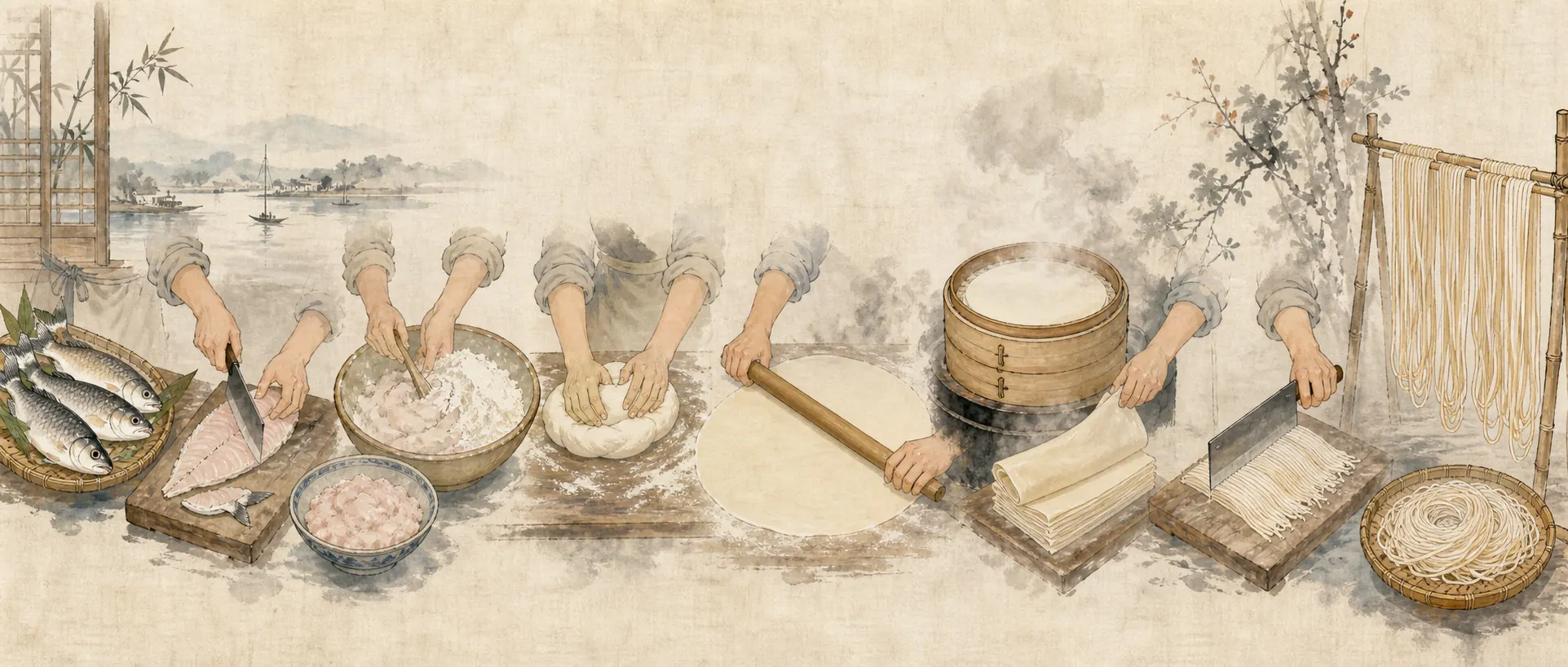
For a century and a half, Yunmeng's fish noodles were made in family workshops scattered across the county — no signboards, no visitor hours, just masters rolling fish dough at four in the morning. That changes this month. A purpose-built fish noodle heritage workshop, funded by the county and framed as the centerpiece of its "living heritage" push, is scheduled for completion in October 2026 — and it sits, almost too poetically, next to the community where 2,200-year-old Qin dynasty bamboo slips were dug out of a tomb.
What Is Being Built, and Where
According to a Hubei Daily report from May 2026, the workshop stands west of Taolou Manor in Shuihudi community, Chengguan town — a deliberate address. Shuihudi (睡虎地, "Sleeping Tiger Ground") is where tomb No. 11 yielded the Qin bamboo slips that made Yunmeng famous among historians, and the county is betting that noodles and slips belong in the same afternoon.
The project covers about 0.75 hectares and was approved on February 11, 2026. Two investment figures circulate in official-adjacent reporting, and they measure different things: the construction contract value is 11.2018 million yuan, while the county's overall investment in the project has been described as "nearly 20 million yuan." We keep both numbers as reported rather than merging them. By August 10, the main structure had taken shape and crews had moved to interior fit-out and surrounding facilities, according to field reports.
The People Behind the Noodles
The workshop's credibility rests on one name: Liu Wenhua, a municipal-level intangible heritage inheritor who entered the trade at nineteen and has now spent 44 years rolling fish dough. County reporting says he was involved in the workshop's planning from the start, holding one line — the core handwork stays manual. His rule of thumb, quoted in Hubei Daily: a 260-gram piece of dough must be rolled within two minutes into a sheet two millimetres thin and sixty centimetres across, then cut with 108 strokes.
The county has also started training the public ahead of opening. On August 13–14, 2026, the county culture bureau ran free fish-noodle classes at the county library, taught by Liu Wenhua together with county-level inheritor Wu Chunfeng and his wife Ouyang Xiaoli — part lecture, part demonstration, with participants rolling dough and tasting noodles stir-fried on site. Classes like these are expected to become the workshop's regular programming once it opens.
The stakes are real for the local economy. Yunmeng now counts more than 30 fish noodle producers turning out over 3,000 tonnes a year, an industry worth roughly 400 million yuan. The workshop is designed as the visible front end of that chain: county documents describe linking upstream fish ponds, mid-stream processors and national sales channels, with a second display point already operating in the Xiangyun Bay scenic area.
Why This Particular October Is a Big Week in Yunmeng
The workshop is finishing during the loudest week on Yunmeng's calendar. During the 2026 National Day Golden Week, the Yunmeng County Museum — home of the Shuihudi slips — rolled out a "four seals" passport game: visitors collect stamps at stations themed on the slips, the wooden letter tablets, the long goblet text and the Eastern Han pottery tower, trading a full set for a gift-box souvenir. A holographic version of "Xi," the Qin clerk whose tomb held the slips, now narrates the law codes, and primary-school docents in red scarves guide holiday crowds. The museum extended closing time to 6:30 p.m. for the holiday.
The county also issued a combined ticket for its two flagship scenic areas — Xiangyun Bay and the Chu King City "Spring-Autumn Fantasy City" night park — at 68 yuan, valid September 25 through October 7, with half-price guided tours at the museum and other heritage venues and discounts at fifteen partner businesses. A week-long outdoor music carnival (September 29 – October 5) anchored the evenings. Local reports note Yunmeng received 858,000 visits over the eight-day National Day holiday last year; this year's infrastructure push suggests the county expects more.
Planning a Visit: What We Can and Cannot Promise
Honesty first: as of October 5, 2026, the workshop's completion in October remains the reported plan. We have seen no official opening announcement, ticket policy or visitor hours, and an unfinished construction site does not receive guests. Do not travel specifically for the workshop until the county publishes opening details — we update our 2026 news tracker (中文) as soon as verifiable information appears.
Everything else on the trip is ready now. The museum and its slips are open (free admission; holiday hours as posted). Our own restaurant — run by this site's team — sits about 50 metres left of the museum exit and serves fish noodles three ways daily, 8:30 a.m. to 8:30 p.m.; see how to find us (中文) and what Yunmeng fish noodles are if the food itself is new to you.
Getting there is simpler than it used to be. Yunmeng East station has been on the Wuhan–Shiyan high-speed line since 2019, and on June 30, 2026 the Shiyan–Xi'an section opened, completing the Wuhan–Xi'an high-speed corridor — Xi'an to Wuhan now takes as little as 2 hours 41 minutes. Trains, frequencies and exact journey times vary by day, so confirm on official rail channels before you set out.
Sources
- Hubei Daily (2026-05-14): workshop location, investment and functions
- Hubei Daily (2026-08-14): public heritage classes and the October completion plan
- Field report (2026-08-10): main structure taking shape, interior fit-out underway
- Yunmeng Media (2026-10-01): museum's National Day programme and extended hours
- Yunmeng County government: Golden Week combined ticket and consumer programme
- Shiyan Evening News (2026-07-01): Shiyan–Xi'an HSR opens June 30, completing the Wuhan–Xi'an corridor