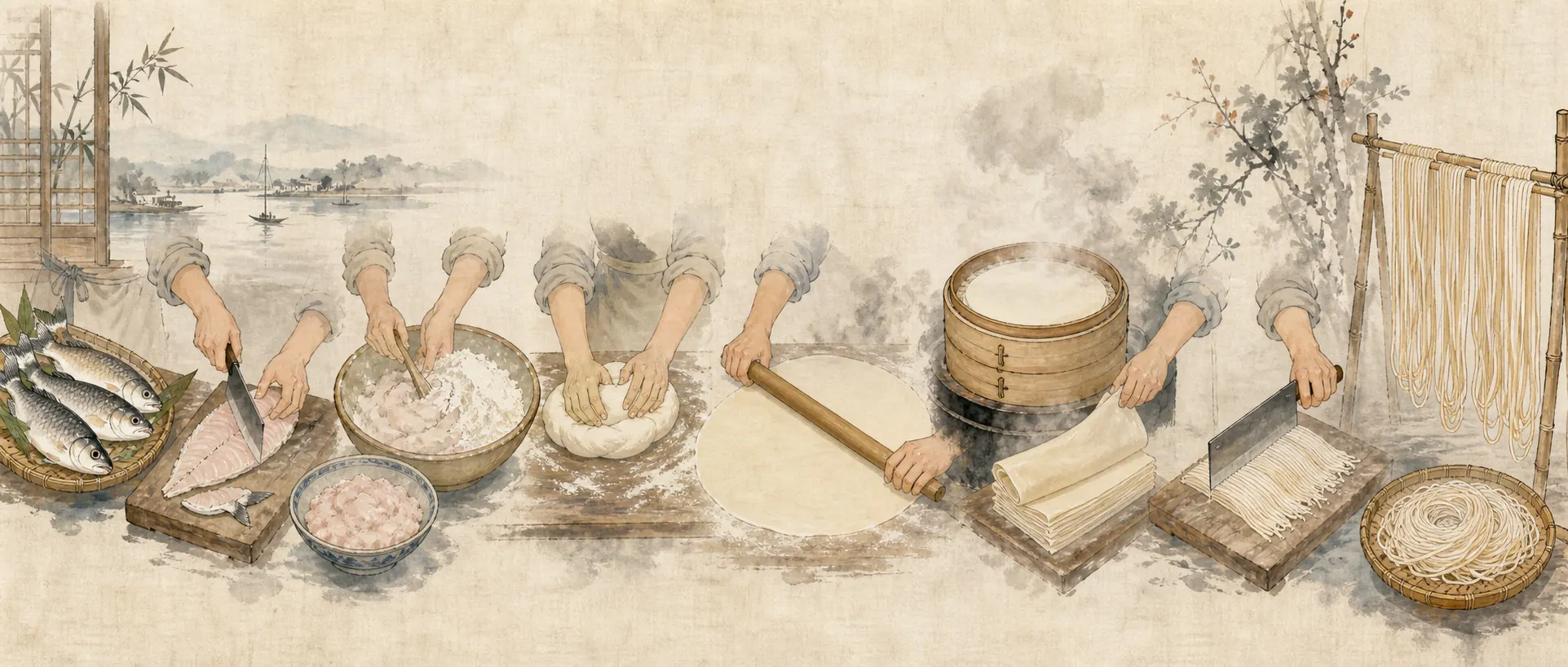
Yunmeng Fish Noodles (Chinese: 云梦鱼面, also called China Yunmeng Fish Noodles or "silver-thread fish noodles") is a traditional food from Yunmeng County, Xiaogan, Hubei Province, China. Its defining idea is simple and strange at once: fresh fish is minced into a paste and kneaded directly into wheat dough, which is then rolled paper-thin, steamed, cut into fine strands and sun-dried. The result is a noodle that looks like noodles but tastes of fish — the local saying is "fish you cannot see, noodles that are not just noodles."
Where It Comes From
According to Yunmeng County records cited by the Hubei Provincial Department of Culture and Tourism, the dish dates to 1835, the 15th year of the Daoguang era of the Qing dynasty. Local tradition tells of a chef surnamed Huang who accidentally knocked a bowl of fish paste into his flour, kneaded the two together rather than waste it, and discovered that the accident tasted better than the plan.
Whatever the exact origin, the food travelled well. In 1915, Yunmeng fish noodles won a silver medal at the Panama-Pacific International Exposition. Later honours accumulated: recognitions as a "China Time-honoured Brand," geographical-indication product protection for "Yunmeng Fish Noodles," and inscription of the making technique on Hubei Province's intangible cultural heritage list. A provincial standard for the geographical-indication product (DB42/T 465-2025) took effect in July 2025, defining the craft in law as well as legend.
How It Is Made
The core sequence is to clean and debone fresh fish, mince the flesh into a fine paste, combine it with wheat flour and other labelled ingredients, roll the dough into thin sheets, steam it, cool and fold it, cut it into fine strands, and dry it for storage. Recipes, fish species, ratios, seasonings, cutting methods and drying times vary by producer; packaged products should therefore be judged by their own ingredient list, producer information and instructions. Hubei's current geographical-indication product standard is DB42/T 465-2025.
How to Eat Them
Dried fish noodles are remarkably versatile. Three preparations dominate local tables: boiled in clear or bone soup, where the strands turn tender-slippery and the broth turns faintly sweet with fish; stir-fried after a warm-water soak, classically with Yunmeng's pickled white-flower vegetable, pork slivers and chili, all gloss and chew; and deep-fried until the strands puff into a golden, crackling tangle that works as a snack. The noodles hold their shape — they do not sludge in soup or shatter in a wok.
Trying It Today
Yunmeng County sits in the Jianghan Plain. Yunmeng East station has been on the Wuhan–Shiyan high-speed line since 2019, and when the Shiyan–Xi'an section opened on June 30, 2026, the Wuhan–Xi'an high-speed corridor was completed — Xi'an to Wuhan now takes as little as 2 hours 41 minutes. Train times and frequencies vary by day, so confirm on official rail channels before travelling. The county is investing heavily in its food heritage: a dedicated fish noodle heritage workshop funded with nearly 20 million yuan is scheduled for completion in October 2026 (opening details were still pending at our last check), offering visitors a look at the full craft. Yunmeng is also home to the Shuihudi Qin bamboo slips — some of China's earliest legal documents — so a trip pairs naturally: two thousand years of legal history in the museum, two hundred years of noodle history in the bowl.
For more, see the full history of Yunmeng Fish Noodles, the step-by-step making process, the three ways to eat them, and what's new in 2026 — or visit our restaurant near the Yunmeng County Museum.